Tuesday, May 27, 2014

Info Interview: John Nastos

John Nastos
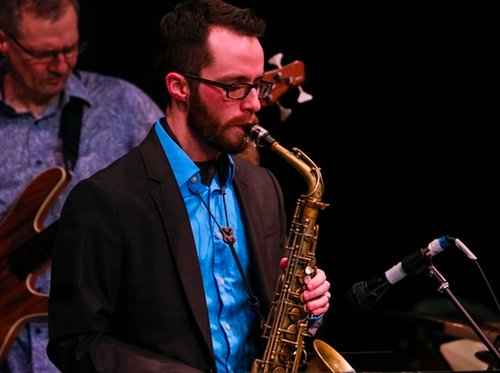
John Nastos, one of Portland's most prominent saxophone players.

If you like jazz and live in Portland, then you’ve likely seen or heard John Nastos. He graduated from the Manhattan School of Music in 2007 and has been making a ruckus ever since. Although, music is not all Nastos makes, he's also a talented programer. Need proof? Check out his pretty amazing metronome app, Metronomics. During our lunchtime interview Nastos was thoughtful and easygoing. Our conversation centered around the business of “making it” as a musician (part one below), but he was also open to my more personal questions about navigating a marriage in such an unpredictable career (part two coming later this week). So, without further ado...

Part One: The biz


Levi Downey: Thanks again for coming to hang out for a bit. I started to work on some of your lesson plan. Working backwards from the 7 to the 1 of each chord in Autumn Leaves has been challenging. Harder than I thought.
John Nastos: Yeah, knowing a tune to that level really helps. If you try to do that to another song you think you know well and you go, ‘Do I really know this tune?’ If I don’t, then how much am I faking when I’m soloing?
LD: What do you mean by “faking it”?
JN: Well, just like, ‘I am going to play this because I think it should work’ rather than, ‘I’m going to play this because I’m confident and I know that it will work’.
LD: Interesting. I’ve been thinking about that lately. I’ve been listening to my playing. It can be frustrating because I hear the same things being used over and over. In my head at the time I don’t remember it sounding like that.
JN: [Laughs] I know the feeling.
LD: So I have a bunch of questions for you.
JN: Go for it. LD: I recently read a book by Radhika Philip, Being Here. She is an anthropologist that lives in NYC and interviewed a bunch of musicians about how/why they create music. One of her many great questions is:
What is the intent that drives your music-making? Specifically the creative process of ‘I’m going to compose this, or I’m going to arrange this this way’.
JN: Interesting question. There is, at least for some people, an important distinction between what I’m doing for artistic purposes and what I am doing because I need to make a living doing it. For example, this video project I did with Clay Giberson, where we [filmed an original composition/arrangement] every day for a year.


One of the last Duo Chronicles videos made, featuring drummer Charlie Doggett.


The project [Duo Chronicles] came about partially because I was playing a musical. It was 8 shows per week and I couldn’t sub it out. There was no improvisation -- just reading. Same show every night. And I couldn’t play any other gigs because the shows were always in the evenings. It gave us this great creative outlet we could accomplish despite the sort of functional things we were doing to earn a living. I think he [Giberson] was teaching an insane number of classes at Clackamas Community College so he was into that same idea too.
We just put it online for free. We weren’t trying to make money off it. But, it also didn’t cost us anything really.We bought a camera and some video editing software. Overall, way under $1,000 to make. Which was much less than a CD would have been. And at the time, there wasn’t any sort of high minded artistic ideas except, ‘Okay, we want to do something that’s satisfying.
It wasn’t even like we were going to do something new. We did it because we like to write music. And we knew that elements of this were really going to push us because that’s a lot of material to come up with every week.
There are also other gigs that I play where I feel like they are really artistic and there are very little compromises that are made. I like Chris Brown’s gig for that reason [Chris Brown Quartet]. Everyone plays at a high level.  I like the charts and the musicians. There are other gigs where it’s just not that great. I’d like to swing the pendulum more toward the first option. Some people have the right idea because they’re like: Hey if you’re gonna try to build your own brand. And people want to see you, then you should play the gigs that put you in the best light.
LD: Yeah, but that doesn’t necessarily pay the PGE [Portland General Electric] bill.
JN: Yeah exactly. That gets a little tough sometimes.
LD: So you draw a clear separation between the “making a living” work and the “art” work. But, even then you might be happy to play some gig even if it’s not your favorite thing. But, at least it’s still better than an alternative profession where you might not be as happy.
JN: Definitely. Well, if I was playing 90% gigs I didn’t like, I might have a different opinion. But, certainly the balance I have right now is nice. I’d much rather do this. And I feel pretty confident that I could get a programming gig making a lot more money. But, then I wouldn’t get to do this and practice and all the other great stuff I love to do. So I hope that will always stay true, but who knows? I’m a little lucky, and have a skewed point of view on this because I’ve literally never had a “job.”
LD: No way. Because you were pretty much a professional musician from an early age?
JN: Well, I played enough in high school to make some money. Not a ton. Enough to have some spending money. And my parents weren’t like, ‘We’re not giving you any money!’ They helped with stuff like bus passes and things like that. Or to go see some shows. I always had enough money to see some music. I went to a lot of shows.
Then, I went to college. And I had a really good scholarship so that was nice. It provided a lot. My parents and grandparents set up a college fund, too, which covered the rest. So I didn’t really have to work then. And by the time I was done in college I was making a living with music.
LD: That’s like the dream everyone’s shooting for, right? Go to school, graduate and you’re doing what you love.
JN: It’s nice so far. If the jazz scene completely disappears, and I’m forced to then get a “job”, it could be a total disservice to me in that I don’t know how to function in the kind of environment of a “real job”.
LD: I see a sitcom in the workings: “John Nastos, in a the corporate gig”.
JN: Haha. Yeah. It might not go well. On the other hand, since I’ve figured out how to make a living as a self-employed musician, I think that if I needed to, I could be self employed in some other field. I now know enough of those sort of general concepts to make it work. Rather than just having to go do a corporate gig.
LD: Did you ever consider not coming back to Portland?
JN: Well, I knew I was going to want to come back eventually. Mostly because I just didn’t like the city [New York] very much. It really drove me crazy. Haha. Almost to a literal sense of going crazy.
LD: The sheer excess of the place?
JN: I guess. Part of it is that it’s just a really dirty place. And there’s no way to escape it. You’re just in it at all times. Yeah, I really didn’t like that. I felt like the highs there were really good. And then the general standard of living was way down here [points to floor].
I felt like in Portland, the highs weren’t going to be as high, but it was all going to be right around here [circles hand mid-high above the table]. Rather than being way down low most of the time. And it just depends on your personality type. If you just live for those high moments, then it’s the absolute perfect place for you. But, I would much rather have sort of a general consistency.
So, it didn’t take long. I knew by probably my second year studying there that I wasn’t going to live there forever. It turned into, ‘How long can I stand it here’. And it turned out that it wasn’t very long at all.
LD: So, you finished a four year program in three years [at Manhattan School of Music]?
JN: Yeah I did.

LD: Did you take a bunch of extra classes or have an insane workload? How did you do that?
JN: No. Well, a little bit. They had this really great program -- which is no longer available -- where all you had to do was learn all the curriculum for the senior year. You could just do it on your own. You didn’t even have to take the classes. And then you take the senior jury. I don’t even remember how the ratings work; something like 1-5 ratings. I don’t know if the juries actually made a difference. They’d say that if you get below a 2+ then you can lose your scholarship. If you were below a 3 then you could even get kicked out.
If you wanted, you could take the senior jury at the end of your junior year. Then if you passed, you had to do your senior recital. You had to take one humanities class every year which I did at PSU that summer. I was so unsure of my playing that I didn’t know if I was going to make it through the jury. But, it was worth it to try. I’ve always hated putting myself out there to the point where I might just publicly fail. So I waited and did my recital during the next school year. I had actually already graduated but hadn’t done the jury.
LD: Wait what?
JN: You know in high school when they won’t give you the diploma until you pay your library late fees? It was kind of like that.
LD: Haha. I see.
JN: Yeah, so I took the jury, passed and stuck around for a few months. But, it was funny. I was flying back to Portland for work.
LD: What were the gigs you were doing in Portland?
JN: Well I was definitely flying back for the Tuesday nights with Mel Brown. It seemed bizarre because I didn’t really want to be in New York, but I was subsidizing my living in New York with my work in Portland. At the time, there was a resurgence in younger folks leading their own bands and actually making some money doing it. Performing in more places than just Jazz venues.
If I could schedule three gigs I would have enough to make it work. Tickets were cheap! Like $175 for round trip on Jet Blue. So if I could make $300 bucks then I could fly back.
LD: So what year was this when you were going back and forth?
JN: 2006 and continued through 2007
LD: Then you came back to Portland and kept up the Mel Brown thing. And now you’re involved with many different groups: Stan Bock’s New Tradition, the Christopher Brown Quartet, and his father, Mel Brown’s Septet.

What other projects are you involved with?

JN: There’s the Ezra Weiss Sextet. Although that’s one where we had a regular gig at Ivories, which is now going out of business. Yeah, there are several groups where we will have to find a new place to perform. Also, I’m in the Chuck Israels Orchestra, the Kevin Deitz Sextet, and the Bobby Torres Ensemble.
LD: There has got to be some obscure one that you don’t even tell people about right?
JN: Well, there are some that have gigs that come around every once in a while. You know I used to have a lot of big band gigs -- back when big bands existed.
LD: Yeah that’s funny. There are actually like twenty or so big bands in Portland. But, they only exist when there’s a gig -- which is rare.
JN: The only one that I know of that’s regularly performing is the Bureau of Standards big band. I’ve played in there a few times. They play at Tony Starlight’s like once a month or so.
LD: Like the house band?

JN: No, they’re not that regular. One of the first gigs I got when I moved back in town was lead alto [sax] with the Art Abrams big band. And that worked about twice per month. The money was always pretty decent. And now it’s like twice per year.

LD: So you were probably on the call list for quite  few different groups.

JN: Well the Carlton Jackson/Dave Mills Big Band had a gig about once per month at the Secret Society and that went away this summer.
I subbed in some like the Woody Hite Big Band -- I don’t think they work much anymore.

LD: It’s really amazing how fast the demand shifted away from big bands!
JN: Yeah it makes the whole jazz education thing really sort of bizarre because in most schools one of the main focus points is on the big band.
LD: I’ve been thinking about that, too. If that’s all you learned how to do (play in a big band) then what do you do when you graduate and there are no more working big bands?

JN: And, yeah. You can’t even go listen to one. I think the only real way to learn how to play this music is to go hear it live.
LD: What about studio-type gigs? Do you do many recordings?
JN: Yeah there are a few producers that will call me for sax and woodwinds. There are a few gigs that come up here and there. There’s this one British producer that has only ever called me to play flute. He’s never called me to play sax. But, hey, I’m fine with whatever.
I don’t think Portland has ever had a really big commercial recording scene. Obviously there are places like LA where there’s jingles. NYC and Nashville, too. But, in the Northwest for whatever reason the big scene was Vancouver, B.C. They had a nice little session scene up there. Maybe not that big anymore -- but it was pretty big. Recording is a nice thing because you can do it during the day. It’s good and important to have some of those.
LD: Another question I was wanting to get to: What are the portions of your income and where do they come from? You teach, you’re on the call list for projects and you have the residencies.
JN: It’s shifted over time. I’m teaching more than I ever have before, definitely. In terms of what I can actually expect and count on each month then it’s probably pretty evenly split. But, a little more on teaching, then gigs, then the metronome app is there too.
Teaching is straightforward; more students, more money. It’s a pretty easy equation. There isn’t a lot of variance in the amount of money I make. Assuming I’m in town for the lessons. Like in February, I was out of town for a while then all the rehearsals for the Jazz Fest. So I just wasn’t able to teach as much. So that income was lower. Still, I kind of know what to expect. I’ll look at the calendar and know roughly how much I’m going to make in a month. Some students will cancel and I might pick up a new one here and there -- so I have a general idea.

Gigs are kind of like that. I know roughly about how much on my weekly gigs. I’ll probably work certain weekend days and it will be a certain rough amount. But that is the category with more unexpected income. [That category] can have a lot of variation from month to month based on whether or not [low or high paying] gigs come along.

If I get a commission to do an arrangement for someone, that’s great. That can be a category that might be zero dollars one month. And might be as much or more than all the other income. It’s the unexpected things that really make a difference.
LD: So that must be really hard to plan ahead.
JN: It is. That’s why I keep taking more students. It’s that baseline that I know I can expect. Then, it’s great when the unexpected things come up. Then I don’t have to count on it.
LD: So you mentioned the metronome application you built [Metronomics]. You seem like someone that said, ‘Most metronomes don’t do x’, so you just built your own.
JN: Pretty much, yeah.
LD: Was it always a plan to make it an application for other people [as well]?
JN: Well fairly early on in the development I knew it was going to be useful for me. And so I thought with a little more polishing, I bet other people would find it useful, too. I wanted it to be easy to use. So yeah, I spent another few weeks to make it presentable. Then released it and it’s been out for about three years now. Yeah, it turned out to be a good investment of time. Even though it took a bunch of time to develop the first few versions.
LD: Did you learn how to program while building the app?
JN: I learned how to program for iPhone, yeah. I had done a very small app for the Duo Chronicles [the video project with Clay Giberson]. But that was very basic. So yeah, I had to learn how to build it while I was making the metronome. I had done websites and stuff like that before. But certainly nothing to that scale.
LD: So I went to the talk at PSU with Ahmad Jamal a while ago. My favorite part was the last question Darrell Grant asked was the standard: “What kind of advice to you have for up and coming musicians”? And he replied with something like: “Always leave yourself options. Leave yourself more than one exit door because when there’s a fire, you’ll be trampled if you only have one”. He listed about six different revenue streams. So I can see how you seem to be doing that. I knew about your performing and teaching but I forgot about your arranging work. You have multiple revenue streams going.
JN: Yeah there just has to be. Kind of relating back to what I said about New York and coming back for the standard of living. I could definitely survive with a more simplistic lifestyle -- and that is not to say that I am even remotely extravagant. I am not. I spend no money -- But, I have a car and a house and health insurance and a nice computer and enough money to buy an instrument every once in a while. A level I feel relatively comfortable. Oh, and retirement contributions.
If all I cared about were practicing and playing what I want to play, and I didn't care about all those other sorts of comfort things, I’m sure I would make less money and spend less money. But, I’d rather just work a little harder and have those things.
LD: That’s great to hear you’re really making it work. It’s not like it was a cakewalk to get to where you were, though.
JN: Yeah and it is definitely possible. You know some people my age… I just get nervous you know. Having exit doors is so important. I mean the people my age sometimes don’t seem to think certain amenities are essential.
LD: Like health insurance?

JN: Well yeah, but also even renter’s insurance. But, I guess the people that make me even more nervous are the fifty-year-old musicians that are making a living, but don’t have a plan for retirement. I mean it’s great if you want to work forever. And I hope they can; I think that’s something to aspire to as a working musician. But, what if something happens and you can’t play anymore? What are you going to do?
LD: You must have had very practical parents.
JN: Haha, yup definitely.

LD: Just a few more questions for you. Do you consider...

TO BE CONCLUDED (check back later this week :)


Wednesday, April 30, 2014

John Gross Interview: Part Two (the lesson)


The second half of my interview with John Gross was all about the music. If you play sax and you’re into multiphonics (weird fingerings to produce multiple tones at once) then chances are you’ve directly or indirectly learned from Mr. Gross. He wrote the bible on the subject, Mulitphonics for Saxophone. However, we didn’t geek-out on multiphonics in my lesson. We covered tone, melody interpretation, practice philosophy, practice strategy and, well, you’ll see what else:

PART TWO - The Lesson

John Gross: Origin Records photo
JD: I’d like to start with tone production. Play something for me. Anything.


LD: (I play a melody I’ve been working on)


JG: Now, when you play. Let me know if you feel any tension in your body. So play a regular C scale. Pay attention to any stress or tension you feel in you body - including your chest or face.


LD: (I play a cautious C scale). Yeah, I feel tension in my lower stomach and in my upper jaw and upper face - like I’m squinting.


JG: Okay, that has to go. Period. If you go on Youtube and look at the great players. They are very relaxed. No tension, no stress. I would observe some of the great players. They’re working hard but they are not tight or stressed out. When they play, they are completely at ease with their instrument. With most of them it’s because they’ve been playing for forty years.  Or even ten years. But you have to be as relaxed as possible.


If you’re feeling stress in here (points to lower stomach) then you aren’t breathing right.
The best way to learn how to breath is free. Download it free online.


A book, you’re going to want to write this down, called The Science of Breath by Yogi Ramacharaka. It was published around 1903 or something like that. You need to learn the “Yogi Complete Breath.”


LD: That’s great! Thank you, I’ll check it out.


JG: Go through all the exercises and find ones that might help your tone production. Not that your tone is bad. Your tone is okay. You just aren’t breathing right. Because you were never taught - it’s really simple.


I was on the road with Lionel Hampton and one of his trombone players turned me on to this book. And I still have a copy and use it all the time.


LD: Great, thank you. So my air support...


JG: Air SUPPLY.


LD: My air supply?


JG: Right, supply. If you fill your lungs correctly you will already have enough support. The beauty about the saxophone is that you cannot put too much air through the instrument. It’s impossible to do. It’s physically impossible. Like the clarinet [for example] you can put too much air through and it backs up because it’s a cylinder. The sax is a cone.


Velocity might be part of your issue. But, you know, it’s a cone so you can’t ever fill it up because of the physics of the cone. There is no point where the horn won’t do more. It’s up to you. Just the breath alone will do it for you. You want to be able to play really soft and really loud and every gradation between.


JG: Let’s talk about practicing smart. What does that mean? To you, what does that mean?


LD: Maybe, being more focused or honest about what you’re practicing.


JG: You only have a limited amount of time to practice. So how much time do you practice everyday?


LD: Always at least an hour and 2 to 4 hours per day on a good week.


JG: My recommendation is 2 to 3 per day. So during that time what do you usually do?


LD: I’ll start with scales and long-tones to warm up. Then I’ll move on to any patterns or licks I’ve been working on. And if I still have some brain power left I’ll run through some Jamey Aebersold tracks. [for those that haven’t burned your brains out of Jamey Aebersold: it’s a playalong system with “minus-one” tracks designed for the use of aspiring jazz musicians]


JG: Then what?


LD: Usually by that time I’ll take a break.


JG: Now what do you do with the Aebersold stuff.


LD: I’ll pull up the chart I’m working on. I’ll work on the melody and then work on memorizing the changes. Arpeggiating the changes and root movements. Then improvise freely.


JG: Now, do you do this consistently. Or every once in a while?


LD: For sure two or three times per week.


JG: Charlie Parker practiced 3 to 8 hours per day for two years before he decided to play in public again. He never really talked about what he practiced but when he was done he sounded really good. A lot of us practiced a lot when were were in our 20s and 30s. I did even though I was a drunk. I still got better, a lot better. So then I started thinking - well what is it that I need to work on.


What do you need to work on?
What can’t you do?
Do you know?


LD: Well I can’t really do the overtones or altissimo notes.


JG: Are those important?


LD: They can be I guess. I’m more concerned with my tone. I’ve been working mostly on my tone lately.


JG: Well what do you hear? Is there a tone in your head that you’re not getting.


LD: Sometimes yeah.


JG: Then follow that. There is some really good information that Steve Lacy disseminated about playing the saxophone and about playing music. I think he has a bunch of good ideas about this. He was a great saxophone player. None of his Soprano notes were ever out of tune.
He talked about going into a practice room. He picked two note. Just two notes, a half step away, and doing nothing but playing those two notes... for 8 hours straight. After about 2 hours he said that he started to hallucinate. Now, I’ve tried to do it. I can’t even make it an hour. I thought, wow that’s really something.


LD: Not even changing octaves?


JG: No. He said that it’s amazing how much space there is between those two notes. I really need to try and do that again. You get hints of [that space] when you practice. Of course he knew every tune that Monk ever wrote. He knew all his music. Steve is extraordinary, he became one of the best saxophone players ever to play the instrument.


Pablo Casals, when he was 90, would practice a ton. Why did he still practice? He said, “Well I think I’m making progress.” Haha.


You could live 500 years and never explore all the possibilities that your brain can think of. There’s a guy Joe Maneri, his son Mike Maneri is a vibes player. Joe taught at New England Conservatory of music. He developed a system of playing quarter tone through Saxophone using different fingerings.


But let’s get to playing something. You have your Aebersold out so let’s play something.


LD: [I have Autumn Leaves on my to-learn list and the audio is ready to play so I hit play and start to play the melody. But, John interrupts me before I’m halfway through the chorus]


JG: You’re playing the melody wrong. Play the melody right


LD: [I restart the melody]


JG: That’s wrong [he stops me again]. Get the book out. If you want to know what the real changes are you need to go to the library and check out how the composer intended it to be. They have the original scores and sheet music... they probably have it online by now. But, what was it the composer intended. Okay, you have the music out now. Let’s try it again but this time play the melody right.


LD: [Off I go. And then begin to solo. A solo I’m not particularly happy with... I remember feeling a lack of enthusiasm - could have been better but it is what it is]


JG: Now, have you listened to yourself play?


LD: A little bit.


JG: I would suggest you record yourself and be ruthless. And discard everything you don’t like. Now, what are you trying to do?


LD: You mean make it through without sounding bad?


JG: Well, what is your intention? You’ve shown me you can read the notes but you have to decide how you want to play the melody. You have to decide how you want it to sound. And then when you improvise. What is your intention? You say, you’re just trying to make it through?


LD: Yeah... sometimes I feel like I don’t even know where I am in the tune.


JG: That’s because it’s a difficult art. Period. Now, I suggest that you listen to yourself and then compare the way you play the tune to other peoples versions. And see how you stack up. I mean, it’s a competition here. So you must compare yourself to the very best. Period. I mean had you come into a jam session and played I’d say “well you don’t seem quite sure what you want to do.” You’re sort of making the changes but what do you want to present to other people that you find in the tune?
If you’re just trying to make it through the changes then you’ve got a lot more work to do.


LD: So it sounds like I’m wandering?


JG: Well for one, there’s not a great swing feel going on. And there isn’t much of harmonic interest happening. There isn’t much that grabs my ear. There’s an awful lot of thinking that goes into playing. An awful lot of study. I would suggest you listen to all the alto players you can find playing over this tune and steal all the parts you like. Because that’s what we all do.


Some people say that Stravinsky first said this: “good composers barrow, great composers steal.”


If there is something that catches your ear - learn it! And analyze it and say what is it about this phrase that I like. And then, if you want to you can learn the phrase and how it fits into the chordal patterns. Then you can change it to make it your own. But, it’s all using your brain.


You copy. You assimilate it. Then you synthesize it. Clark Terry said it better. But, first you have to know what you like.


First listen to every alto player you can find. Then, listen to everyone you like and only them. If you hear some alto player play and you don’t like it. Figure out why you don’t like it. Then move on and keep looking for what you do like.


I started out listening to Charlie Parker and then gravitated toward Paul Desmond and Lee Konitz. Art Pepper’s earlier stuff was really beautiful too. His later stuff not so much because he was trying to do things he could no longer do. But, heroin and alcohol ruined his life.


I like the new guys too. Steve Coleman, and Kenny Garrett, Greg Osby and so many others that play in that style. I figured out - I was shown - where they learned that stuff from. They learned it from Bunky Green from Chicago. He played that way in the 1970’s. He developed that style of playing. He was playing the hippest shit way back then before everyone else.


LD: How do you describe that style?


JG: I don’t know how I would put it in words. You have to hear it. It’s a unique thing. All those newer guys do it. Some are a bit more intellectual and some are more emotional but it’s that style. What a tremendous influence on that generation of alto players.


I met him one time. I was playing in Chicago in 1980 with Toshiko. It was part of the Chicago Jazz Fest. Toshiko was nice because she made sure everyone had a feature and I had a feature. So I did my number. And afterwards this little black guy comes up to me as I’m getting into a cab and says “Do you know what you’re doing?” It’s Bunky! I said, “yeah I know what I’m doing.” Haha. So that was nice.


I’d like to see him again. Just to, you know, thank him for what he’s done.


Bunky was one of those guys that was largely ignored in the 1970s. Not in Chicago - he was working all the time there. But it took a while for his influence to reach places like New York.


And to know where Coltrane came from you’ll have to listen to Gene Ammons - and a bunch of other players that came before him. There are also some older recordings of John Coltrane playing alto.


Now, practicing. You have to know what you can’t do.


Someone once asked a big name player how he is able to play so well drunk. He replied, “Well I practice drunk that’s how!”


But, what’s the underlying message in what he’s saying? Everybody I have ever talked with has a different way of practicing. It works for them and that’s all you need. Find what works for you and do it. If you want to play drunk, practice drunk. If you want to play classical music, practice classical music. If you want to play Jazz, then practice Jazz!


Okay, what’s the most used scale?


LD: Maybe the dorian?


JG: No! It’s the chromatic scale. Have you mastered that scale?


LD: Well, probably not mastered it, no.


JG: Okay, what’s the second most common scale?


LD: ...not sure.


JG: It’s the pentatonic. (he plays it very quickly in a couple different keys) Sound familiar? Do you know it in all keys?


LD: No, but it sounds very familiar.


JG: Okay write out the notes. Any key just write out the scale.


LD: ( I do this... slower than he would’ve liked)


JG: Okay, now write all the chords that that scale fits in.


LD: (I struggle for an awkward 20 seconds)


JG: Okay let’s start on G (grabs my notepad I was using). What chords will fit in that scale that all chord tones are completely consonant? Okay now go to Ab. Would that scale work in the Ab chord? Now go to A.
(We continued this for several minutes)


So how many chords will this scale fit over completely consonantly?


LD: Looks like 7.


JG: Yeah! And that’s not even using any altered chords. If you add those it will fit even more! So is it a good scale to know or what?


Okay now what is the third most common scale?


LD: I have no idea.


JG: It’s the 9 note scale or double diminished or the whole/half diminished scale. Now what chords fit within this scale? We don’t have much time so here (he writes out the chords it works with).


It’s the one that is most used under the diminished chords. There are three of them and if you learn them you have something to play over all the dominant and diminished chords.


This is our vocabulary:
Chromatic
Pentatonic
9-note scale


Then you need to know where to put them in. They don’t say it like this in school. But, what you want to do is what has been done before and then develop your own. There are countless books of scales. But, what I would recommend is to develop your own.


There are other things. Practicing tunes.


A great tenor sax player, Ellery Eskelin, has a great blog. He has a very similar approach that I  take to learning a tune.


I take a tune. For example I’ll take Autumn Leaves (grabs the chart from the music stand) and I’ll take each chord note by note and take it through each chord of the tune. For example, take the first chord (Cm7). Take the root (C). And see how far it will go in the tune before it becomes the wrong note. Where does it fit where does it not fit? What changes does it sound good under and what changes does it sound bad under.


Then you take the next scale degree, D, and see where it fits and where it doesn’t. So on and so forth through the entire implied scale of the first chord of the tune.  Then you go to the next chord and do the same thing. Start with whole tones all the way through the tune. In time. Your body and your mind will remember this.


Then do the same thing but pick any scale degree of the first chord. Go up a direction or down a direction on each new change - but stay within a degree or two; don’t move to far from the previous note. Go through the tune until it becomes absolutely boring. Then, move to half notes. Hah! And then to quarter notes or half-note triplets and then eight notes. So on and so forth.


Do see what an intellectual game this is? You have to master the tune before you can play it. As they say, learn everything you can then forget everything and play.


So I don’t know about six months.


One thing that is key is playing with other people. Now in this day in age it’s a little harder. But, I know all over the city there are people, many many people in basements and garages trying to learn this music. It’s very important that you learn how to play with other people’s playing. How to listen and respond to each other. That’s what we did growing up and that’s what they are doing today. The idea is to find people who play as well as you do or better and play with them on a regular basis.


Music is something that needs to be played together. You could spend all this time in the practice room and come up with some unbelievably great shit. And then you go to play it out and they won’t be playing what their playing on the Aebersold records.... and it won’t work because you haven’t practiced playing with other people.


And it has to be fun.
Okay, is that enough for you?


LD: That was a lot of info for one day.


JG: And there are lots of people that practice in completely different ways and they become very good. People do things to practice that I disagree with but it works for them. So don’t have a closed mind to different approaches.


One of the sayings we have in the music business is “Don’t give up your day job”


LD: Haha, well looks like I was a little late on that advice.


JG: Hah, yeah. But, I never tell anyone that they can’t do it. Incredible progress can be made in a short period of time. What you have is a good instrument, a decent sound, a decent mouthpiece, and you’ve got some time.


So when you play you need to record yourself. Listen to yourself and compare your performance with the best performances you can find. It’s not going to be pretty. But, you have to decide on what level you want to be. What are you shooting for? If you want to be with the best you have to compare yourself with them. You don’t want to just be the best alto player in the neighborhood.


You need to listen to yourself critically. Always be critical of yourself and kind toward other people. But, hard on yourself. Because these are things that no one else will tell you.


I suggest we meet in a couple of months. And play. Not until early May.


Use your brain. Be hard on yourself. Figure out how you can best use the time that you have.

LD: Thanks John.